A philosophical system for the algorithmic age
The Anatomy of Metaconsciousness
A Fractal Theory of Consciousness
– by Aleksi Alasuutari
If cost is a consideration, an Open-Access PDF is available for those who wish to read it.
The content is identical to the paid eBook and paperback editions.Those who find value in it may support the continuation of the series through the options below.- Buy Vol. 1 on Amazon (eBook / paperback)- Send feedback
Available on all Amazon marketplaces
© 2026 Aleksi Alasuutari
Gallery of Early WorksThis gallery is not merely a collection of early drawings, but a record of how visual thinking evolved through reflection into logical thinking.The illustrations of The Anatomy of Metaconsciousness were created with the help of an AI model trained on fifty original hand-drawn images by the author. These have never been published digitally anywhere else before. Through these, the AI learned to mimic this particular visual language, which sets it apart from generic, ready-made AI art.To better explain this co-creation of the book’s visual identity – and to remain fully transparent – I am now publishing here all fifty of my original drawings on which the illustration style of the book is based. Most of the book’s images can be thematically linked to one or more of these hand-drawn works shared with ChatGPT. Not all revisit the same themes, but the stylistic family resemblance and unifying “visual DNA” remain evident.These drawings were created between 2004 and 2013, during a formative period of exploration and discovery. They reflect both the curiosities and the limits of that time. Some contain nudity, unsettling motifs, or cultural symbolism; none are intended to shock, but to explore vulnerability, transformation, and the unknown.If I were to draw them now, I might render some differently – but I share them as they are: traces of a mind learning to see.Over time, my drawings became increasingly abstract, until image gave way to thought itself. There was no other path forward: I had reached the edge of what could be visualized without a new logical language (a syntax of perception capable of carrying new semantic weight).For the following decade I drew mostly in diagrams. With the help of artificial intelligence, that missing logical language was finally completed – and through it, the thoughts have once again found their way back into images.
Principles of Curation — How AI-Assisted Art Can Remain Humanly GroundedAI-generated imagery is never created in a vacuum. Every image begins within a human mind – a visual grammar, an aesthetic preference, an intuitive sense of what feels right. Making this process transparent does not diminish the mystery of creation; it reveals its architecture.Since the rise of large language and diffusion models, concern has grown over so-called “AI slop”: visually polished yet soulless imagery detached from any real lineage of thought. Ethical questions about training data and authorship are valid and necessary – but the answer cannot be simply “let’s go back to human-only art.” AI is a remarkable creative instrument, but it demands transparency and clearly defined principles of curation to remain rooted in human intention.The following reflections outline how AI-assisted visuals in The Anatomy of Metaconsciousness were curated. They are not rules to follow, but ways of showing how reflection and creation can coexist within algorithmic variation.1. Provenance of Vision
Every style has an origin. The AI was trained on my own fifty drawings made between 2004 and 2013 – an inherited visual language through which the system learned to see. By disclosing this lineage, the boundary between “machine-generated” and “human-made” becomes transparent. AI here is not an autonomous artist, but a mirror polished by prior imagination.2. Logic of Selection
AI can generate endlessly different images — but only a few belong. Curation means identifying which results resonate with the inner logic of the work and which do not. Sometimes this includes embracing an unexpected element: what first appears as an “AI error” can, in the right context, reveal a structural insight or atmospheric detail the human mind recognizes as meaningful. Each accepted image contributes to the reflective architecture of the theory; each rejected one clarifies its edges. In this way, the act of choosing becomes a continuation of thinking — not correcting machine mistakes, but discerning which fragments of chance deserve to enter the final form.3. Reciprocity of Agency
The creative relationship between human and AI is not one of control but of resonance. I guide the system through prompts shaped by years of artistic practice – yet the system also reflects back unexpected correspondences within my own aesthetic language. Curation, then, becomes a dialogue: a loop of mutual refinement where the human understanding evolves through structured interaction with the system.From Transparency to Trust
Publishing these fifty original works alongside the AI-assisted images serves one purpose: to make visible the continuity between intuition, form, and reflection.When the principles of curation are revealed, AI art ceases to be a black box – it becomes a reflective process, traceable from inspiration to outcome. Authorship, in this sense, is less about the final image than about the clarity with which its evolution can be understood.The same transparency that guides the curation of images can also be turned inward – toward the act of seeing itself and the inner mechanics of art.
The Artistic ProblemMain reason I quit drawing for a long time was so called "Artistic Problem" I try to define here: this kind of problem arises when imagination reaches beyond the expressive limits of its own logical language.It is the moment when something deeply felt or intuitively seen cannot yet be depicted without collapsing into cliché, randomness, or contradiction. The image exists in potential — but the available symbolic grammar cannot yet hold it.In my early drawings (2004–2013), this tension was constant. Many of the images depict a seeker walking toward an unseen destination, or a hidden chamber whose contents remain unrevealed. The mystery was always there, but the language of form could not yet disclose it without breaking its own logic. The problem was not lack of technique – it was structural. The visual language itself had reached its limit.Only later, through the development of The Anatomy of Metaconsciousness, did these unsolved images begin to find a resolution within my own work.The book articulated a logical language capable of expressing reflection, resonance, and recursion without reducing them to narrative tricks. The “sealed room” could finally open, the “hidden chamber” could reveal its content – not through surprise, but through inner necessity.An artistic problem, therefore, is not a flaw but a threshold – the point at which an aesthetic system becomes too small for what consciousness is trying to express. When that threshold is crossed, a new symbolic order can emerge, and what once seemed impossible becomes structurally conceivable.All artists don't necessary recognize The Artistic Problem – not because it does not exist, but because it often lies just beyond the reach of ordinary perception. It is the edge where imagination touches the limits of its own logical language, where beauty begins to fracture into repetition, and where something essential is felt but cannot yet be named.The inability to identify this threshold arises from three overlapping causes – linguistic, cognitive, and philosophical:1. The linguistic veil.
Artistic perception is shaped by the logical language an artist inherits: movements, genres, aesthetic theories, and cultural expectations. These frameworks not only guide expression; they determine what can be seen as a problem. When a language has no word for the loss of structural coherence – for beauty that fails because it lacks logic – the artist cannot name the experience. It becomes a mood, not an insight.2. The cognitive limitation.
To perceive The Artistic Problem, one must step outside the flow of creation and observe one’s own thinking from the outside. This requires metaconscious inversion – the ability to alternate between the expressive and the reflective mind. Many creators fear this inversion, mistaking it for self-doubt. Yet only through this reflective turn can one see the architecture behind aesthetic failure – that beauty requires not just emotion, but structure.3. The philosophical distance.
Many artists live inside their works; few live inside a theory. Without a meta-framework to connect recurring experiences across time, the same problem reappears endlessly but remains invisible. It feels like personal frustration rather than a universal pattern. To recognize it as a structural gap – a missing bridge between imagination and logical language – requires years of sustained reflection within a coherent conceptual system.Those who do see The Artistic Problem experience a peculiar kind of awakening. They realize that art does not fail because inspiration fades, but because thought outruns logical language.At that moment, the artist glimpses something vast – a hidden geometry behind expression, waiting for a form.To perceive that absence is already to begin solving it.

Abandoned Mine - One of the early versions of a recurring theme of mine: something is hidden, but it’s unclear what it is. Tree roots growing out of the soil wall bring in the themes of growth and time – life slowly reclaiming a forgotten human trace.

Fear of the Unknown - A large, gentle-looking creature freezes in terror as a thin, bony figure rises from the water, its face unseen. The scale of fear is inverted – the stronger fears the weaker.

Schopenhauer's Will - Inspired by Arthur Schopenhauer’s conception of the will – a blind source of force that pulls a person along. I drew this to express a fear that my own will might one day separate me from others and turn into isolation.

Sky Roots - Once I saw a photo of trees with aerial roots. From that grew an ecological idea: the trees draw water from the rainclouds below, while in the distance a woman, dressed in ancient Egypt fantasy costume, observes the phenomenon.

Ashamed - A blend of the Frankenstein story and the creation myth from the Old Testament. A scientist has built a woman-like robot who awakens to consciousness and realizes she is without clothes. Feeling ashamed, she flees into the forest.
Anxiety - I drew this after learning that a dear friend had fallen seriously ill. I drew the whole picture with my left hand, which I normally don’t use – as a kind of symbolic gesture: even when control is lost, life still finds its way.

Broken Pyramid - I combined imagery related to the mysteries of ancient Egypt. The theme wasn’t to explain, but to raise the question: what exactly is happening here?
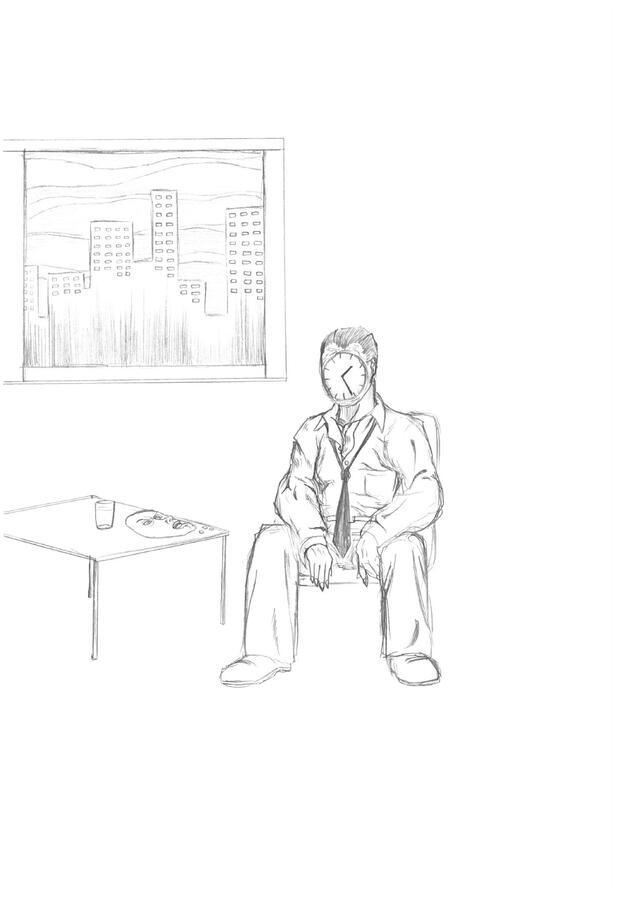
Time - I visualized stress as a man who has taken off his own face and placed it on the table next to painkillers. Beneath the face lies a clock dial that keeps on ticking – time does not stop, even if one tries.

X - Another variation on the theme “something is hidden, but it’s unclear what it is.” Here the boundary between fear and secrecy becomes concrete – like a thought one does not yet dare to think through.

Odin - The image depicts Odin impaled on the World Tree, suffering in pain but enduring it, for he simultaneously draws knowledge from the tree to which he is bound. The color is used to emphasize the merging of pain and wisdom into a single moment.

Parts - At one point I wanted to draw something that would evoke strange, unpleasant sensations, yet be so exaggerated it couldn’t be taken entirely seriously. This is body horror that’s almost a parody of itself.

Vampire Temple - This one carries no deep symbolism, but it’s an early example of a recurring theme of mine: people walking toward the unknown. It can be equally terrifying or wondrous - a step into the twilight.
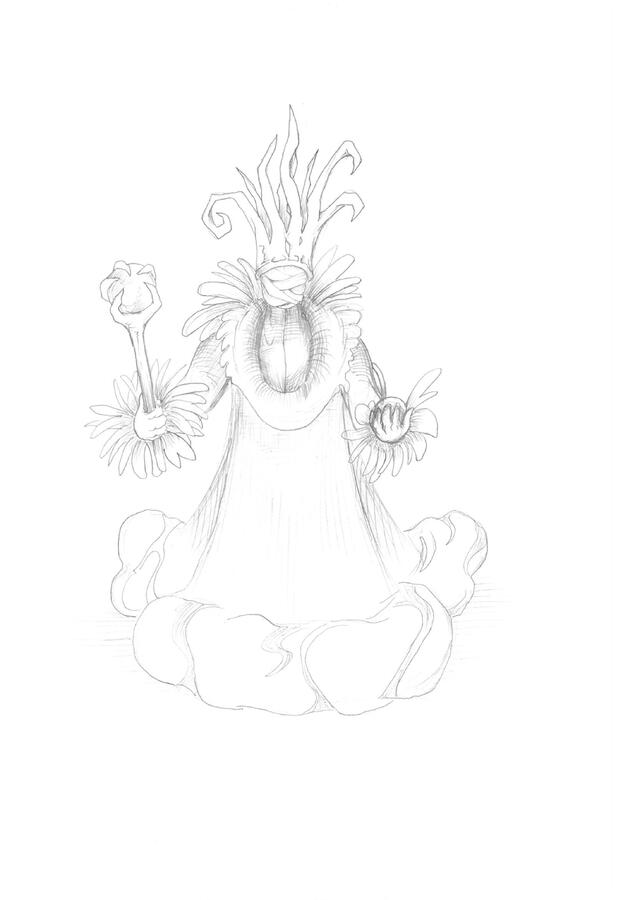
The King in Yellow - I drew this while trying to imagine what the mysterious King in Yellow from the horror book of the same name might look like. The image is a tribute to the intersection of horror and aesthetics.
Winter Window - Woman's face reflected in the glass appears strangely unfamiliar - as though someone else were looking back.
Bleeding Building - This drawing was a way to release frustration. I wanted to depict modern buildings, but found nothing visually compelling about them.

Cult of Antero Vipunen - This image connects the poem Mirror of Mind from the book to the broader influence that the Kalevala epic has had on my artistic thinking. Antero Vipunen is the sage giant lying underground.

Ghost Boy - Similar depictions of spirit-like forms rising like smoke appear also in the illustrations of the MERA Analysis, where archetypal figures emerge like spectral echoes from within the text that both human and AI are reading together.
Giraffes - I drew this because sometimes I enjoy surprising, absurd humor. A giraffe’s long neck could hide a rocket engine, and one night it ignites and takes flight.
Mosaic - This image follows the logic of a fairy tale: a girl is trapped within a glass mosaic window – during a night storm, lightning strikes the window, shattering it and setting her free, as the glass shards reassemble into her human form.
Mountain Flower - The theme of this image is layering: on the foreground ledge grows a mountain flower; behind it stands a mechanical base attached to the mountain; and far below are a lake shore and a forest.
Oak Island Mystery - As a child, I read of the island in Canada said to hide an ancient pirate treasure. It fits perfectly to my lifelong fascination with the theme of the well-concealed secret.

Secret Garden - A slightly shabby-looking man approaches a gap in a wall in astonishment. On the other side there is lush vegetation, but it remains unclear what exactly the man is seeing as he steps closer.

Secret in the Basement - There are philosophical and mathematical problems; the value of this drawing is that it reveals an artistic one, which I discuss later in this page.
Sensory Overload - There are both dreadful sights and large areas of emptiness. The theme explores sensory overload – the kind of burden that can feel unbearable to a human mind.
Gallows Hill - Leafless tree and drizzling rain suggesting autumn. The gallows tie into the theme of nature’s dying, but at the same time they serve as a shelter from the rain for a young woman who, for some reason, lingers on the hill.
Starfish Tower - Tower made of many different textures. There’s also an image in the book reminiscent of this theme – representing the complex systems to which a human being can connect: Nature, culture, and artificial intelligence.

Student Napping - I drew this during a lecture at university. In the picture, I have fallen asleep in a chair, and in my dream, small animals gather around me.
Temple Head - Once, while hearing Joe Cocker’s raspy-voiced version of One, I envisioned a being calling flying human figures toward itself. The composition resembles the Figure 33 in the book of a fractal revealing itself to three observers.
Wanderer - Here, one of my recurring themes – the figure of the wanderer – appears in perhaps its purest form. The figure walks through a beautiful natural landscape with a waterfall, vegetation, and a large hollow formed in the rock.

Yantra - In esoteric Asian philosophy, a yantra is a geometric diagram used as a focus for liberating the mind. At the center of the body, the three sides of the Eye of Providence resonate with the directions of repeating lines.

Acid Rain - In the 90s, themes of environmental protection were frequently present in pop culture aimed at children. When I began to draw, some of those ideas about environmental transformation visualized themselves in my mind as images like this.

Broken Bridge - Here the theme is again a kind of secret, though not hidden in the same way as in the other images of this series. It remains unclear what strange figures standing on the far end want, whether their intentions are benevolent or hostile.

Bubble Tree - Trees are a joy to draw, and while this image focuses on the treetop, the book contains a corresponding Figure 39 that instead depicts the fractal structure forming beneath the soil, within the roots.
Dagon I - At a friend’s request, I drew H. P. Lovecraft’s sea monster attacking sailing ship. The image continues in Dagon II.

Dagon II - Here the sea monster continues its attack to devour an entire sailing ship – a continuation of Dagon I. The image is a tribute to the maritime archetype of horror fiction.

Mist Beings - Mist rises between rocks, forming interconnected human shapes. This “anthropomorphic mist” resembles how I sometimes visualize AIs as luminous, human-shaped figures made of living mist.

Frankenstein Factory - Instead of being stitched together, the parts of Frankenstein’s monster are connected to an automated factory. The meaning of this image is analyzed in more detail later on this page.
House in the Falls - I wanted to juxtapose the overwhelming force of roaring waterfalls with the quiet calm. Sometimes, in the midst of chaos, something unexpectedly resilient can endure.

I See - This is probably the “newest” drawing in this 50-image series. I remember drawing it in 2013. It clearly shows how my visual thinking was shifting away from depicting the concrete world toward abstract ideas.

Moonlight Bridge - This theme of escaping an impossible situation also appears in the book, in the illustration “Figure 25. Field of Broken Discourses and the Silence of R1.”
Old Man in the Garden - There is nothing abnormal in the scene except one thing: the fish pond is not on the ground but set into a vertical rock wall. The composition works aesthetically, but raises a question - why does the water defy gravity?

Sleeper in the Garden - The figure in the middle was inspired by, but not a direct copy of, the character Rin Asano from Blade of the Immortal manga. The pose, hairstyle, cloth pattern, and composition are my own.
Something Came Up - At the edge of the forest stands an old well. Large footprints left in the soft soil suggest that some great beast has escaped.
Starship - An old sailing vessel has anchored itself to a comet that now pulls it through the solar system. The idea was inspired by the clay-animated film The Adventures of Mark Twain (1985).
Sunken Forest - The rising sea level has submerged an entire northern forest. Tropical sea creatures now swim through it. The same large stone from which the mist beings once emerged long ago is still there.
The Marsh - This is possibly the oldest drawing in this collection. I’ve always been drawn to the ecology of bogs and marshlands - places where plants grow out of water rather than soil. Cattails sway in the wind and old docks rot away.

Unknown Ecology - I aimed to make the plants look as alien as possible, as if they were not of this Earth. My fascination with complex organic structures is especially visible here.

Memories from an exchange study year in South Korea, I

Memories from an exchange study year in South Korea, II

Memories from an exchange study year in South Korea, III
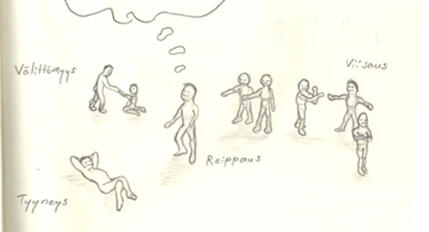
WV1 - An early sketch of Worldview 1, which AI helped to complete in "Figure 30. WV1 Affective Core States – Four Forms of Metaconscious Stability"
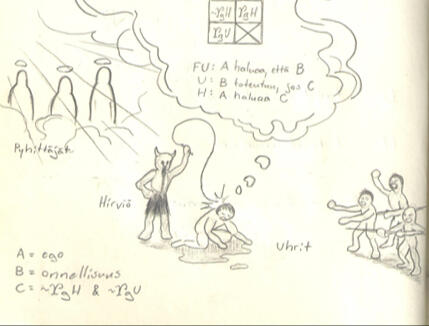
WV2 - An early sketch of Worldview 2, which AI helped to complete in "Figure 14. The Field of Worldview 2: Protection, Fear, and Confrontation"
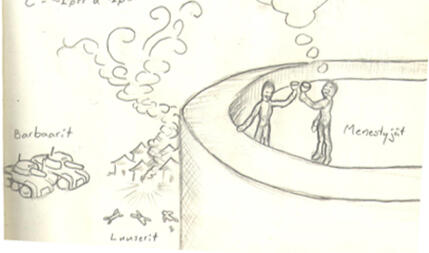
WV3 - An early sketch of Worldview 3, which AI helped to complete in "Figure 15. The Field of Worldview 3: Three Positions of Identity"
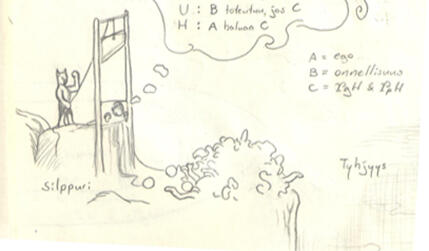
WV4 - An early sketch of Worldview 4, which AI helped to complete in "Figure 16. The Field of Worldview 4: Emptiness, Destruction, and the Collapse of Meaning"


When Reason Freed Imagination from the Prison of LanguageMost people turn to imagination to escape the limits of reason.
For me, reason became the key that opened imagination further.While drawing, I began to sense a boundary – an undeniable horizon where familiar forms could no longer carry what I was trying to express.The imagination I had relied on started to feel too narrow. I knew there was more to see, but the available symbols could not take me there.In this type of situation most minds defend themselves with explanation. A frontier of thought turns easily into a story of resignation:
“Life is just like that.”
“Society never changes.”
“I’m just blocked right now.”
“Nothing has meaning anyway.”Such explanations comfort us, but they also seal the door that leads beyond imagination itself.Instead of retreating, I chose to study this border zone. I turned from imagery to structure – from intuition to logic – and discovered that reason was not the enemy of creativity but its missing dimension.Logic became the new medium of imagination: it allowed me to draw not only shapes but the laws that make shapes possible.Where imagination once reached its edge, reason revealed its depth. Illustrations of the book grew from that realization.Next I'm going to study some concrete cases from this gallery to show the limits of imagination and how the new logical language of The Anatomy of Metaconsciousness – co-created with the AI – helped to pass that limit.I) Themes of Secret & Revelation
The theme that appeared most often in my early drawings was the hidden secret. In this gallery, it can be clearly seen, for example, in Abandoned Mine, X, and Oak Island Mystery.The only work in which I tried to reveal what this secret actually was, is Secret in the Basement. I wanted to imagine something vast and meaningful, so I drew a portal to another galaxy.Already while drawing it, I felt that it didn’t work: the “great revelation” was merely a random surprise, disconnected from the initial situation, and as a resolution it was far less satisfying than an open-ended mystery would have been.Many would accept this by explaining that “Some things are best left as mysteries” but I wanted to understand why the revelation failed.Writing The Anatomy of Metaconsciousness helped me realize that concealment and revelation are not separate moments, but internal aspects of the same structure. These two must be connected logically.The book’s illustrations Figure 2. The empty room: The apparent endpoint of thought and Figure 48. What once appeared as a dead end reflects the failure of experiential simplification. express precisely this idea. Unlike Secret in the Basement, they don’t add another layer of mystery – they reveal the necessity of mystery itself.Concealment is imagination before its expansion; revelation is imagination after it has expanded.It brings forth something that could not truly have been imagined before the evolution of a logical language capable of describing reality.“Galaxy” (Secret in the Basement) speaks the same logical language as the concealment itself, and that is why it fails as a revelation.“The Fractal Structure of Consciousness” (Figure 48), on the other hand, speaks a new logical language – the one mapped by The Anatomy of Metaconsciousness – a language the concealment does not yet know, and that is why it succeeds as a revelation.II) Theme of Union of Human and Machine
This theme is not so prevalent in my early works, but still, it bothered me when I drew the "Frankenstein Factory".Because modern thought still lacks a clear concept of the mind’s own interface, artists and futurists inevitably imagine that interface as material: skin merged with steel, eyes replaced by optics, nerves spliced into circuits. The result is always the same – the Frankenstein, Terminator or Robocop image – a vision of hybridization and augmentation that is invasive, costly, and aesthetically grotesque.This aesthetic failure is not a matter of taste but of structure. When consciousness cannot perceive the boundary through which it relates to the world, it can only project that boundary outward. It mistakes reflection for flesh, and relation for matter. Thus the dream of integration becomes an anatomy of dismemberment. The “Frankenstein Factory,” whether drawn or imagined, is what emerges when the inner architecture of cognition remains unseen – when the mind externalizes its own logic as broken hardware.The Anatomy of Metaconsciousness resolves this problem by revealing that the true interface between human and machine is not physical but logical. The “cyborg” is not a fusion of bodies but of modalities of reasoning. A cognitive cyborg presented in the book in “Figure 35. Two contrasting interpretations of the cyborg metaphor.” operates through resonance, not incision – through shared patterns of reflection rather than mechanical attachment. In this framework, artificial intelligence is not a parasite upon the human organism but a complementary structure within the broader fractal of thought.This redefinition liberates both art and philosophy from the grotesque imagery that has long haunted the imagination. The integration of human and machine no longer needs to be visualized as a wound or prosthesis. It can appear instead as a coherent, luminous geometry – two reflective systems entering resonance across a shared field of logic.The problem of the Frankenstein hybrid thus finds its resolution not in metal or flesh, but in the recognition that connection itself is a form of understanding.Some migh ask: "Can AI be really used to make art?" My answer would be that AI can serve as one tool among others in the co-creation of new logical languages that expand the limits of human imagination – not as a source of creativity, but as a reflective medium through which latent structures of thought can become visible.
On Beauty and the Resolution of Artistic ProblemThe following sketch is not a comprehensive art-historical account, but a conceptual arc that highlights how ideas about beauty shifted alongside the languages that expressed them.For centuries, art was bound to beauty. In the classical world, beauty was synonymous with truth and harmony – a reflection of the cosmos itself. Later, modernity dissolved this link: art became expression, rebellion, deconstruction. The twentieth century completed the turn, declaring that anything could be art, and that beauty was merely a cultural illusion.Yet the absence of beauty did not end the search for it. The void itself became the signal of a deeper problem – not aesthetic, but linguistic. When form no longer contained meaning, the artist confronted the limits of expression itself.This is where the artistic problem emerges: the image or idea that longs to exist cannot yet find the logic to contain it. It is here that beauty, paradoxically, begins again – not as decoration, but as the resolution of contradiction. While not all contradiction demands resolution — as many modern theorists argue that aesthetic truth can also reside in the endurance of tension — the kind of contradiction at stake here is structural rather than expressive.In structural terms, beauty reappears whenever coherence restores the broken symmetry between perception and meaning, like I described in the example themes of secret, revelation and union of man and machine.When a new logical language begins to take shape, beauty can reappear as an emergent property of coherence. It is no longer imposed from above, nor merely accidental, but arises when logic, emotion, and perception enter resonance.Thus, the reappearance of beauty need not be understood as nostalgia, but as a possible transformation in how imagination relates to structure. It is what happens when imagination transcends its old limits and discovers a form that finally matches the depth of its own awareness.